Case Study

Single Patient Viewer

Case Study

Single Patient Viewer

Main Project Image

About

Enhancing a healthcare platform to provide real time insights

This process consisted of assessing the usability of a provincial healthcare software's TB report generation and navigation functionalities. It encompasses the login process, flow, navigation to TB report categories, assessment of report parameters, and interpretation of TB reports. The existing software presented usability challenges, particularly in generating TB reports. Understanding the specific needs of data clerks and clinicians in utilising these reports was crucial for improving usability.

Client

PHDC/Bill & Melinda Gates Health Foundation

Industry

Meditech

Year

2023

Services

UX Research

About

Enhancing a healthcare platform to provide real time insights

This process consisted of assessing the usability of a provincial healthcare software's TB report generation and navigation functionalities. It encompasses the login process, flow, navigation to TB report categories, assessment of report parameters, and interpretation of TB reports. The existing software presented usability challenges, particularly in generating TB reports. Understanding the specific needs of data clerks and clinicians in utilising these reports was crucial for improving usability.

Client

PHDC/Bill & Melinda Gates Health Foundation

Industry

Meditech

Year

2023

Services

UX Research

Large Project Gallery Image #1
Large Project Gallery Image #2
Large Project Gallery Image #1

About Project

Heuristic Analysis:

A heuristic analysis was conducted, applying best practice principles to assess TB reporting usability. This analysis not only highlighted existing issues but also generated assumptions for further testing.

Phase 1 Usability Testing:

Real users were engaged to validate assumptions and uncover usability pitfalls in the current system. This phase aimed to understand users' roles, their current system usage, and the barriers preventing optimal use.

Actionable Feedback and Design Updates:

Testing feedback was consolidated, and recommendations were prioritised by impact. The design team incorporated this feedback into a prototype for the next round of user testing.

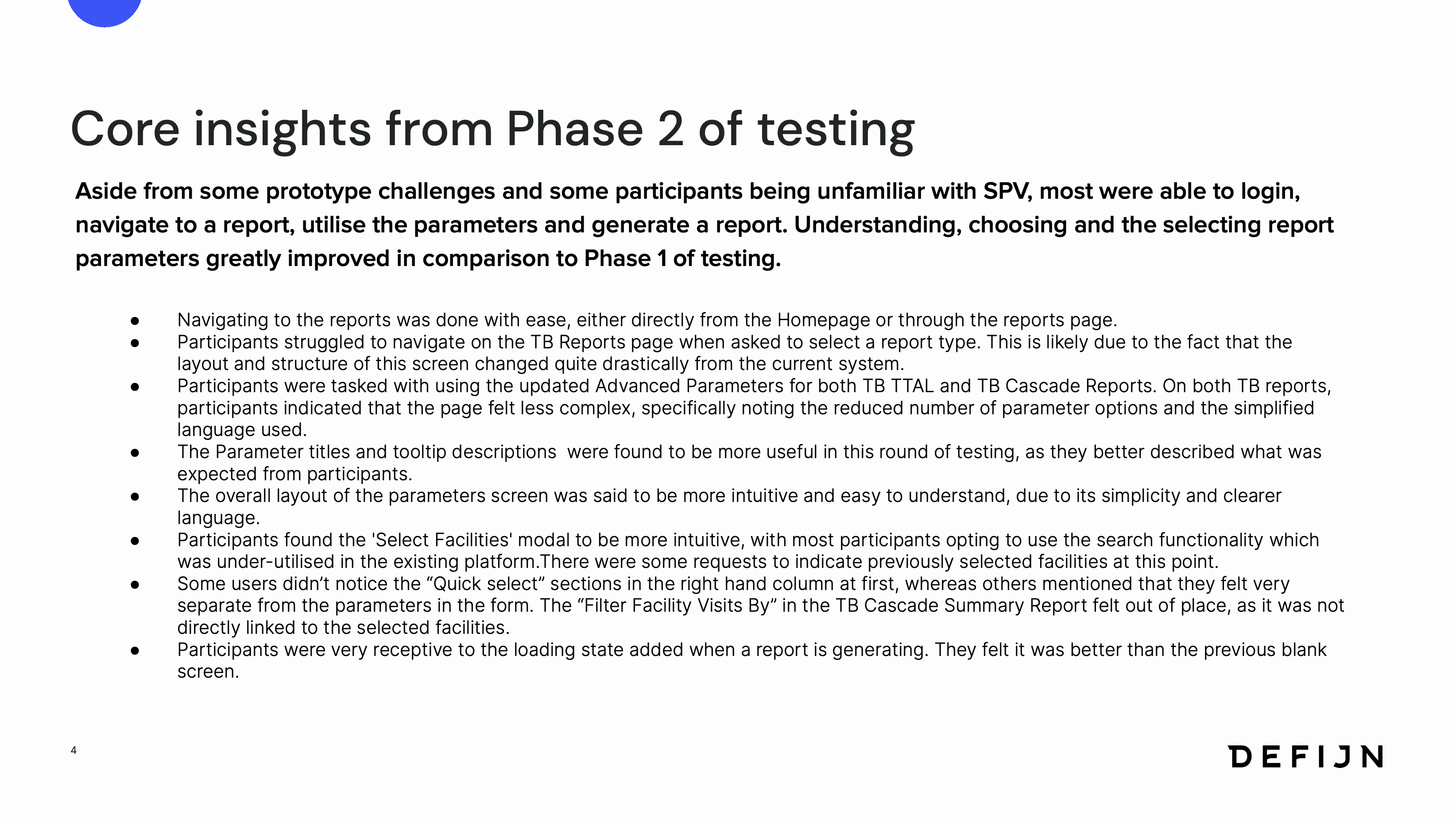
Phase 2 Usability Testing:

The updated designs and prototype were tested with participants to evaluate their usability in accomplishing specific tasks.

Final Feedback:

Feedback from Phase 2 testing was assessed to determine if further design iterations were needed or if the designs were ready for development.

Project Gallery Image for 50% width of the screen #2

Findings My personal take on the value added.

Improved Usability:

The updated designs showed significant improvements in usability, particularly in terms of login and report generation. Although some participants faced challenges with report parameter selection, these issues were identified in the prototype phase, signalling the potential for improvement.

Focused Scope:

By consolidating the scope of testing and refinement, the research team was able to achieve more targeted results, addressing one aspect of the system before addressing the entire system. This approach proved effective in making step-by-step improvements.

The importance of UX heuristics in complex systems

The application of UX heuristics and user testing not only identified critical usability issues but also provided a clear path for enhancing healthcare software. The insights gained have laid the foundation for iterative design improvements, ultimately leading to a more user-friendly system.

Heuristic Analysis:

A heuristic analysis was conducted, applying best practice principles to assess TB reporting usability. This analysis not only highlighted existing issues but also generated assumptions for further testing.

Phase 1 Usability Testing:

Real users were engaged to validate assumptions and uncover usability pitfalls in the current system. This phase aimed to understand users' roles, their current system usage, and the barriers preventing optimal use.

Actionable Feedback and Design Updates:

Testing feedback was consolidated, and recommendations were prioritised by impact. The design team incorporated this feedback into a prototype for the next round of user testing.

Phase 2 Usability Testing:

The updated designs and prototype were tested with participants to evaluate their usability in accomplishing specific tasks.

Final Feedback:

Feedback from Phase 2 testing was assessed to determine if further design iterations were needed or if the designs were ready for development.