Case Study

MoneyClub

Case Study

MoneyClub

About

Digitising the South African Stokvel

Floatpays envisioned Money Club: a digital savings platform that would preserve the community trust and social accountability of the stokvel while adding bank level security, real-time visibility, forming goal-oriented savings, and education to those unfamiliar with digital savings products. I led product design across the savings wallet and club-creation flows, working with one supporting designer. Given the one month timeline, the work focused primarily on execution, but our decisions about information hierarchy and educational framing required careful thinking about who these consumers are and how they relate to money. I also ran a brief competitor analysis to understand how financial institutions structure savings goals and reviewed habit-forming apps (like Strava, Stoic, Atoms) to better understand the behavioural mechanisms we could leverage.

Client

Floatpays

Industry

Fintech

Year

2024

Services

Product Design, UX/UI Design

About

Digitising the South African Stokvel

Floatpays envisioned Money Club: a digital savings platform that would preserve the community trust and social accountability of the stokvel while adding bank level security, real-time visibility, forming goal-oriented savings, and education to those unfamiliar with digital savings products. I led product design across the savings wallet and club-creation flows, working with one supporting designer. Given the one month timeline, the work focused primarily on execution, but our decisions about information hierarchy and educational framing required careful thinking about who these consumers are and how they relate to money. I also ran a brief competitor analysis to understand how financial institutions structure savings goals and reviewed habit-forming apps (like Strava, Stoic, Atoms) to better understand the behavioural mechanisms we could leverage.

Client

Floatpays

Industry

Fintech

Year

2024

Services

Product Design, UX/UI Design

Dazzle Logo with sign vertical
Dazzle Logo with sign horizontal

About Project

Information Architecture:

I created a high level Information Architecture with the most important sections for individual pages, this allowed my fellow designer and stakeholders to see the full scope of the product before we touched any screens. Early alignment and collaboration meant that we could deliver at a higher speed with well-executed designs.

Accelerated benchmarking & wireframes:

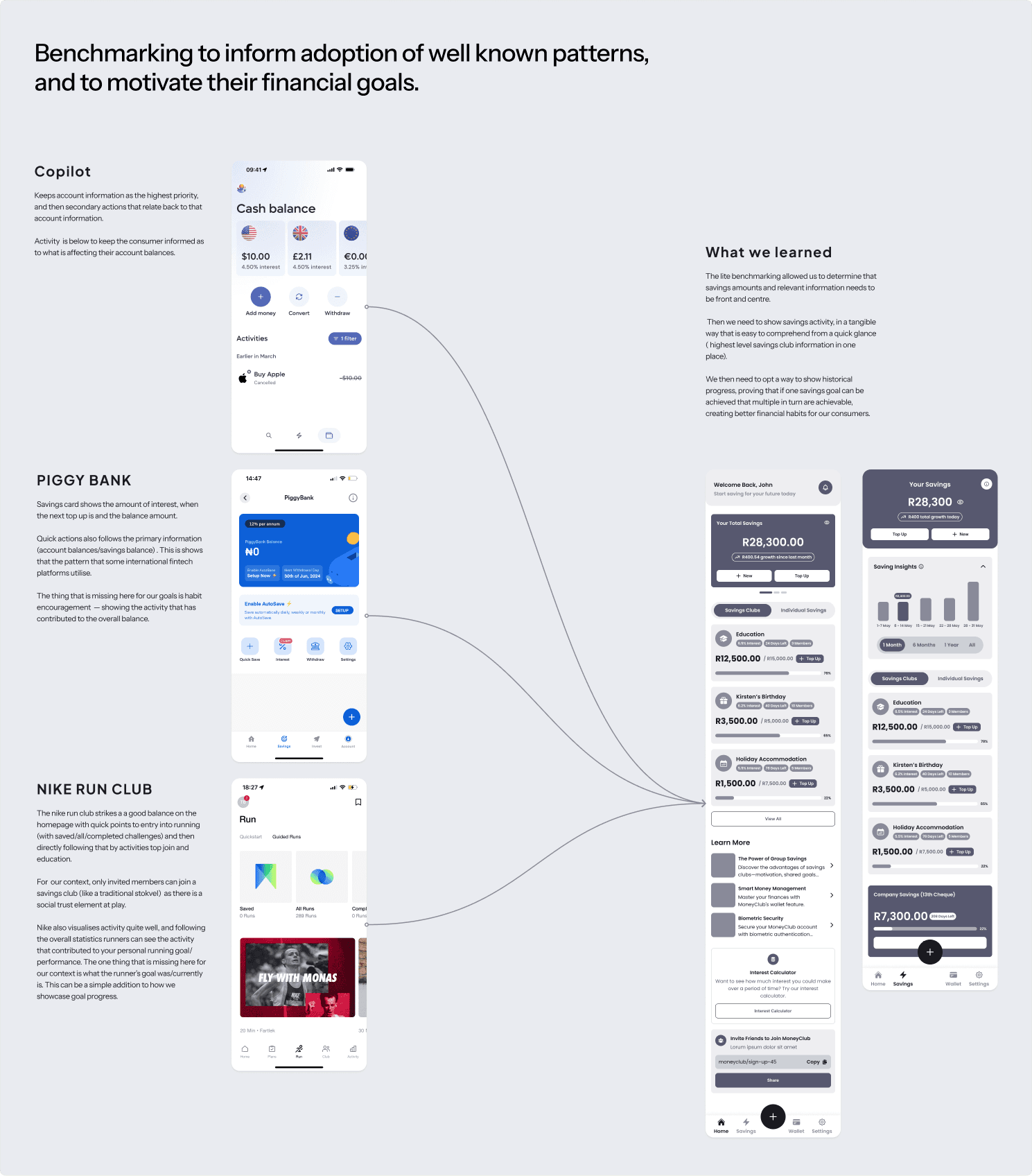
I had a look at some international and local Fintech products and realised the gap of not only community but also of habit building. I then opted to look at indirect competitors that work well with habit building as well as community driven goals/challenges.

UI rollout:

From the high-fidelity wireframes, we jumped straight back into stakeholder alignment, ensuring that designs not only met our goals but also complied legally for a FSP. Rapid iteration took place in the form of UI flows, any feedback received on the wireframes directly translated there to meet timeline expectations.

Project Gallery Image for 50% width of the screen #2

Takeaway

Tight deadlines

A month to deliver a fully fledged product, especially a financial one, is a tight timeline. I learned that process can get in the way when it is followed for process’ sake, and that strong stakeholder collaboration around a simplified goal is key to delivering a great product.

Designing for underserved groups:

Designing for financial inclusion in South Africa means consistently keeping a specific user in mind: someone who may be financially capable through informal systems like the stokvel, but who has been underserved by formal digital finance. That context shapes every label, every empty state, and every error message.

Ownership of work:

Leading this project taught me when to step in and support the team, and when to trust them to reach out for guidance. That leap of faith reinforced my belief that design is not only iterative, but collaborative, and that every stakeholder carries some responsibility for the final product and its success.

Information Architecture:

I created a high level Information Architecture with the most important sections for individual pages, this allowed my fellow designer and stakeholders to see the full scope of the product before we touched any screens. Early alignment and collaboration meant that we could deliver at a higher speed with well-executed designs.

Accelerated benchmarking & wireframes:

I had a look at some international and local Fintech products and realised the gap of not only community but also of habit building. I then opted to look at indirect competitors that work well with habit building as well as community driven goals/challenges.

UI rollout:

From the high-fidelity wireframes, we jumped straight back into stakeholder alignment, ensuring that designs not only met our goals but also complied legally for a FSP. Rapid iteration took place in the form of UI flows, any feedback received on the wireframes directly translated there to meet timeline expectations.